

❋
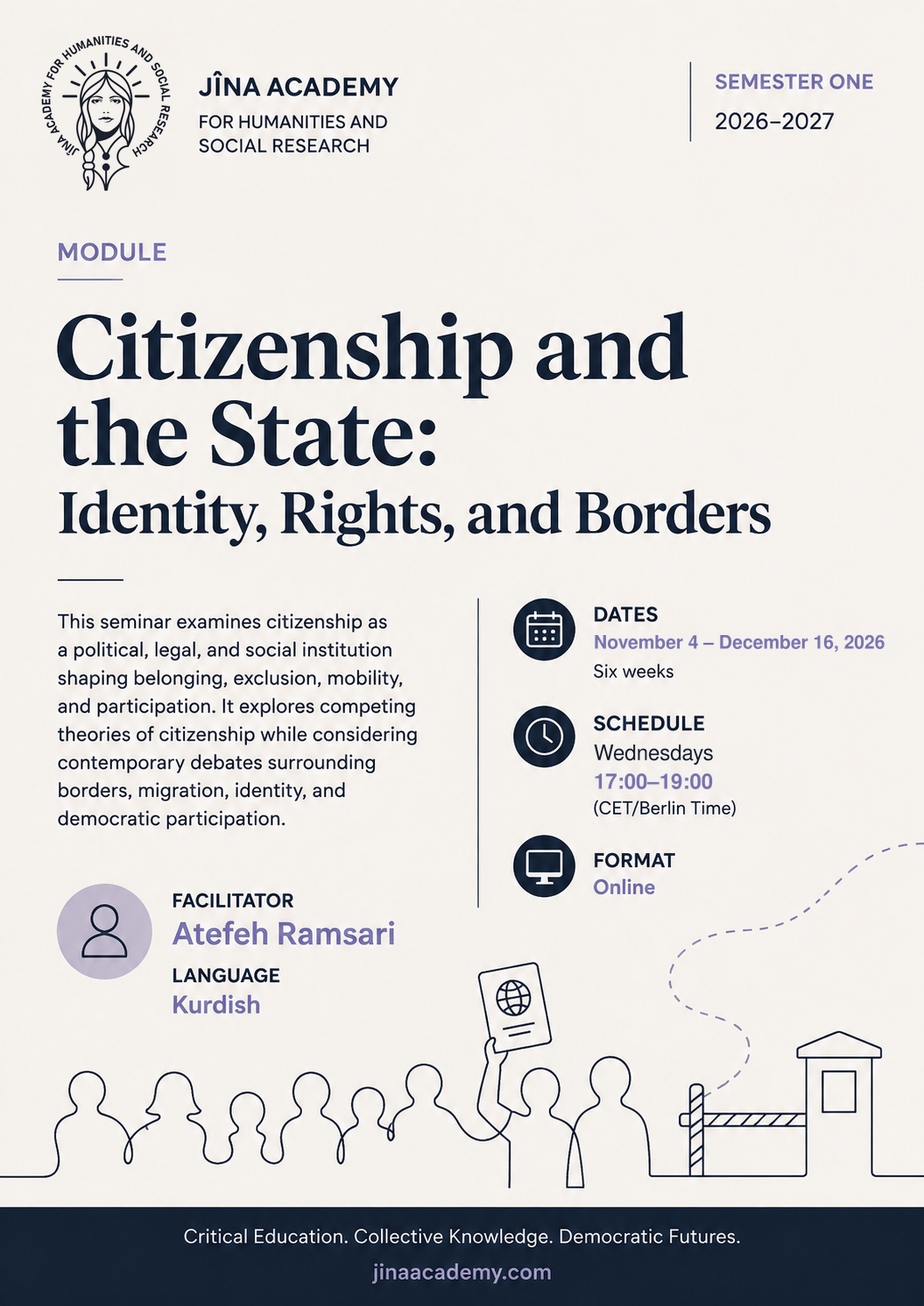
Citizenship and the State: Identity, Rights, and Borders
Facilitator: Atefeh Ramsari
The seminar is facilitated by Atefeh Ramsari, with guest contributions incorporated where appropriate.
This seminar examines citizenship as a political, legal, and social institution that shapes who belongs, who is excluded, and who is able to participate in political and social life. It introduces key theories of citizenship while exploring how states define membership, rights, mobility, and political participation.
Through contemporary debates around borders, migration, identity, and democracy, the seminar considers citizenship not simply as a legal status but as a contested field in which questions of belonging, recognition, inequality, and exclusion are continuously negotiated.
✳ Language: English
The seminar will be taught in Kurdish, with space for multilingual participation and discussion where possible.
✳ Dates & Duration
November 4 - December 16, 2026
Six-week seminar during Semester One of the 2026–2027 academic year.
✳ Schedule & Format
Wednesdays, 17:00–19:00
CET / Berlin Time
❋ Online
Registration is required. You will receive a link for online participation and more information after registration.
Meet Your Facilitator
Atefeh Ramsari, PhD
Dr. Atefeh Ramsari holds a PhD from Bielefeld University. Her research examines citizenship, belonging, and ethnic conflict in multinational societies, with particular attention to the Kurdish context. She has taught courses on citizenship, the nation-state, and social research methods at Bielefeld University and the Institute of Social Sciences at Rojava University in Qamishli.

About the Seminar
Citizenship and the State: Identity, Rights, and Borders explores citizenship as one of the central institutions through which modern states organize political membership, rights, and belonging. While citizenship is often understood primarily as a legal relationship between an individual and a state, the seminar examines its broader political and social dimensions, asking how citizenship determines who can belong, participate, move, and make claims to rights.
Students will engage with different theories of citizenship and consider how its meaning has changed across historical and political contexts. Particular attention will be given to contemporary debates around borders, migration, identity, mobility, exclusion, and democratic participation.
The seminar also invites students to think critically about the limits of citizenship. Who is included in the political community, and who remains outside it? How do states create distinctions between citizens, migrants, refugees, minorities, and other populations? And what alternative ways of thinking about rights, belonging, and democratic participation might emerge beyond conventional models of citizenship?
Join the Seminar
Semester One · 2026–2027
November 4 - December 16, 2026
Wednesdays, 17:00–19:00 CET / Berlin Time
Online · Kurdish
Participants who successfully complete the seminar will receive a Jîna Academy Certificate of Seminar Completion. The seminar may also count as an elective toward the Jîna Academy Certificate in Humanities.